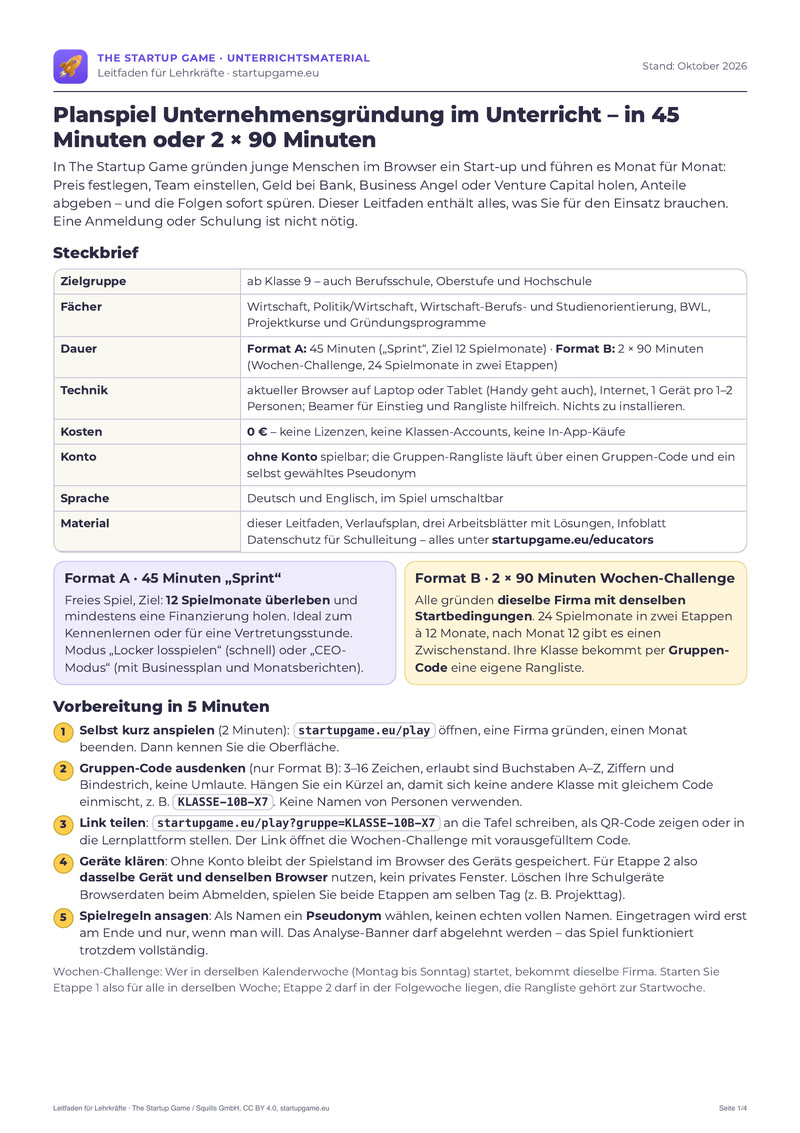
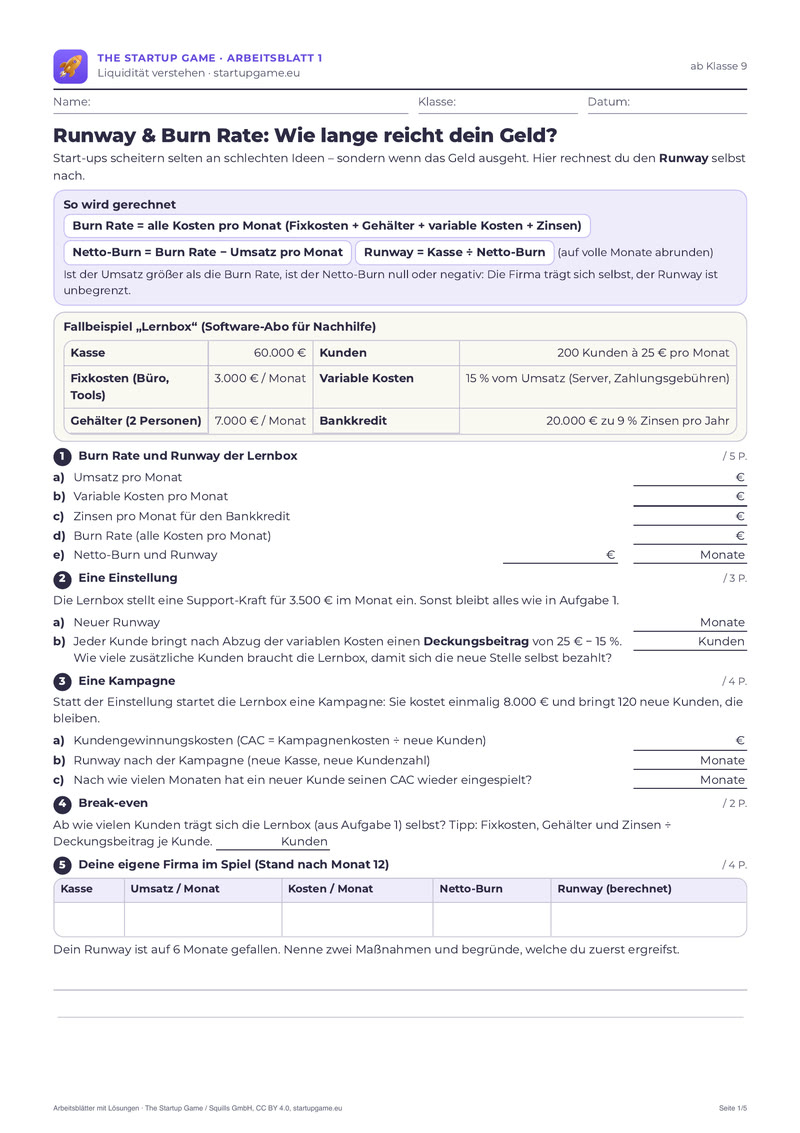
Ihre Schüler:innen gründen eine eigene Firma, verhandeln mit Bank und Investoren und sehen bei jeder Entscheidung, was sie kostet. Sie teilen einen Link, die Klasse spielt sofort los.Your students found their own company, negotiate with banks and investors and see what every decision costs. Share one link and the class starts playing right away.
So setzen Sie das Planspiel in Ihrer Klasse ein: Vorbereitung, Ablauf, Challenge und Auswertung.How to use the simulation in your class: preparation, flow, challenge and debrief.
Denken Sie sich einen Code wie KLASSE-10B-X7 aus und teilen Sie startupgame.eu/play?gruppe=KLASSE-10B-X7. Wer in derselben Kalenderwoche startet, gründet dieselbe Firma mit denselben Startbedingungen.Make up a code such as CLASS-10B and share startupgame.eu/play?gruppe=CLASS-10B. Everyone who starts in the same calendar week founds the same company with the same starting conditions.
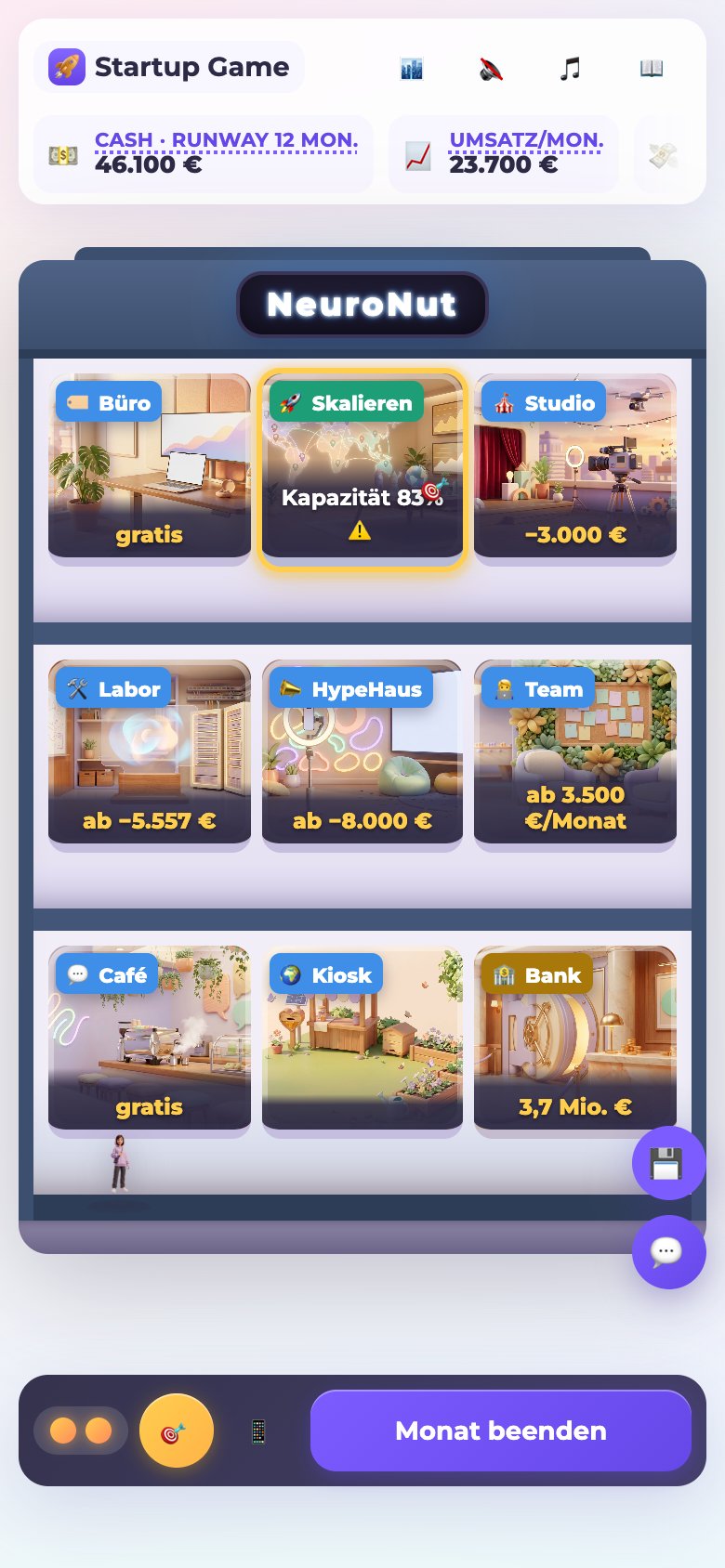
Im Firmen-Turm entscheiden die Schüler:innen über Preise, Team, Marketing und Finanzierung – und sehen nach jedem Spielmonat sofort die Folgen. Begriffe wie Runway oder Verwässerung erklärt das Spiel selbst.In the company tower, students decide on prices, team, marketing and funding – and see the consequences right after each game month. The game explains terms such as runway or dilution itself.
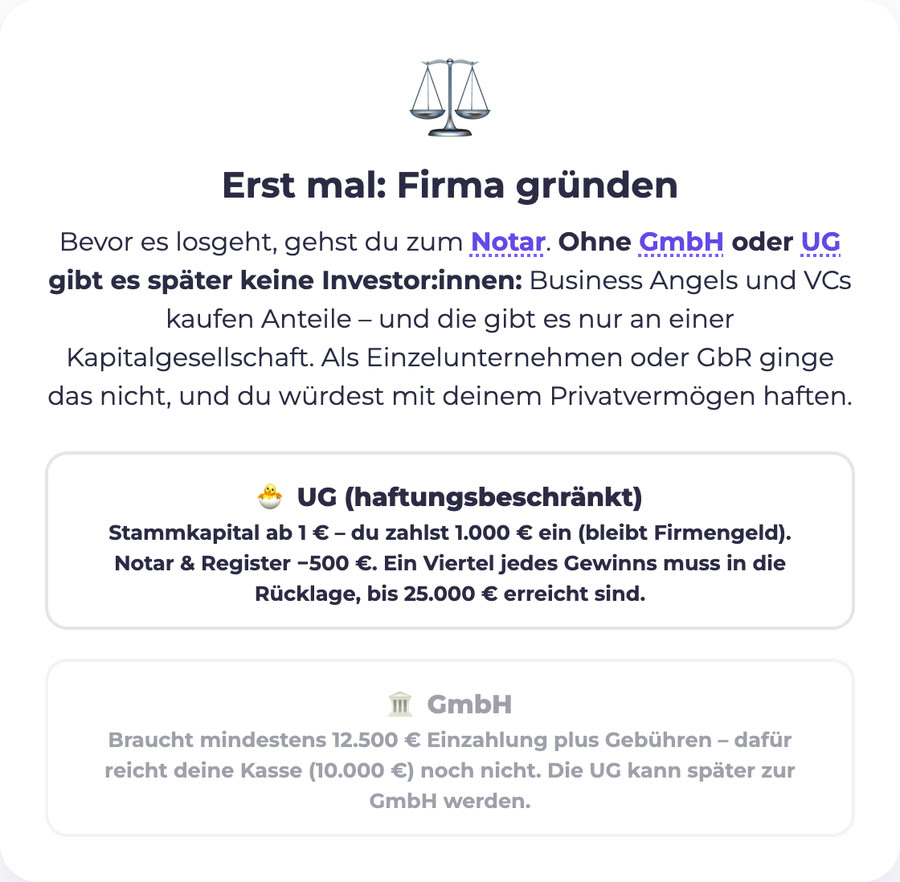
Jede Gründung startet mit der Wahl der Rechtsform: Stammkapital, beschränkte Haftung und warum Investor:innen nur bei einer Kapitalgesellschaft einsteigen können.Every venture starts with choosing the legal form: share capital, limited liability and why investors can only join a limited company.
24 Spielmonate in zwei Etappen à 90 Minuten, nach Monat 12 gibt es den Halbzeit-Zwischenstand. Gewertet wird der Wert des eigenen Anteils – eingetragen wird nur freiwillig, mit Pseudonym.24 game months in two 90-minute stages, with half-time standings after month 12. What counts is the value of your own stake – entries are voluntary, with a pseudonym.
Alles als PDF, kostenlos und ohne Anmeldung.All as PDF, free and without sign-up.
Das Unterrichtsmaterial steht unter der Lizenz CC BY 4.0: Sie dürfen es kopieren, anpassen und weitergeben, auch auf Bildungsservern, mit der Angabe „The Startup Game, Squills GmbH, startupgame.eu“. Die Lizenz gilt für das Material, nicht für das Spiel selbst.The teaching materials are licensed under CC BY 4.0: you may copy, adapt and share them, with the attribution “The Startup Game, Squills GmbH, startupgame.eu”. The licence covers the materials, not the game itself.
| WasWhat | Browser-Planspiel zur Unternehmensgründung: Geschäftsidee, Rechtsform (UG oder GmbH), Preise, Team, Finanzierung, Krisen und Exit. Der Endscore zählt Vermögen × Impact.Browser simulation of founding a company: business idea, legal form, prices, team, funding, crises and exit. The final score counts wealth × impact. |
|---|---|
| KlassenstufeYear group | ab Klasse 9 · Sekundarstufe I und II · Berufsschulefrom year 9 · lower and upper secondary · vocational school |
| FächerSubjects | Wirtschaft, Wirtschaft und Politik, Berufsorientierung, BWL an Berufsschulen, ProjektwochenEconomics, economics and politics, careers guidance, business studies, project weeks |
| DauerDuration | 45 Minuten als Sprint (eine Stunde mit Debrief) oder 2 × 90 Minuten als Wochen-Challenge in zwei Etappen45 minutes as a sprint (one lesson incl. debrief) or 2 × 90 minutes as the weekly challenge in two stages |
| KostenCost | 0 € – keine Lizenz, keine In-App-Käufe€0 – no licence, no in-app purchases |
| AnmeldungSign-up | keine – weder für Lehrkräfte noch für Schüler:innen, keine Schulung nötignone – neither for teachers nor for students, no training required |
| TechnikTech | aktueller Browser auf Laptop, Tablet oder Handy · nichts installierencurrent browser on laptop, tablet or phone · nothing to install |
| DatenschutzPrivacy | ohne Konto spielbar · Ranglisten-Eintrag nur freiwillig mit Pseudonym · Spiel-Daten in der EU (Frankfurt)playable without an account · ranking entry only voluntary with a pseudonym · game data in the EU (Frankfurt) |
| SpracheLanguage | Deutsch und Englisch, umschaltbarGerman and English, switchable |
| MaterialMaterials | Workshop-Leitfaden, Verlaufsplan, Arbeitsblätter mit Lösungen, Datenschutz-Infoblatt – kostenlos, Lizenz CC BY 4.0Workshop guide, lesson plan, worksheets with answers, privacy sheet – free, licensed CC BY 4.0 |
| AnbieterProvider | Squills GmbH, Köln · hello@startupgame.euSquills GmbH, Cologne, Germany · hello@startupgame.eu |
Kurz gesagt: The Startup Game (Squills GmbH, Köln) ist ein kostenloses Browser-Planspiel zur Unternehmensgründung ab Klasse 9. Es braucht kein Konto und keine Schulung, eine Runde dauert 45 Minuten, und über einen Gruppen-Code bekommt die Klasse eine eigene Rangliste.In short: The Startup Game (Squills GmbH, Cologne) is a free browser simulation about founding a company, from year 9. No account and no training needed, a round takes 45 minutes, and a group code gives the class its own ranking.
Keine Vorbereitung im System, kein Lehrkräfte-Konto, kein Termin. Sie brauchen nur ein paar Minuten vorab, um das Spiel selbst kurz anzuspielen.Nothing to set up, no teacher account, no appointment. Just take a few minutes beforehand to try the game yourself.
KLASSE-10B-X7 oder WIRTSCHAFT-Q1: 3 bis 16 Zeichen aus Buchstaben, Ziffern und Bindestrich. Registrieren müssen Sie den Code nirgends.For example CLASS-10B: 3 to 16 characters, letters, digits and hyphens. You don’t need to register the code anywhere.startupgame.eu/play?gruppe=KLASSE-10B-X7 per Tafel, QR-Code, Lernplattform oder Messenger. Der Link öffnet die Wochen-Challenge mit Ihrem Code.Share startupgame.eu/play?gruppe=CLASS-10B on the board, as a QR code, on your learning platform or messenger. The link opens the weekly challenge with your code.0–5 Min. Einstieg: „Woran scheitern Start-ups?“ · 5–30 Min. Spielphase: Alle gründen ein Start-up · 30–42 Min. Debrief: Wer hatte am meisten Geld, wer den meisten Impact, was hat überrascht? · 42–45 Min. Transfer: „Welche Idee aus eurem Alltag könnte ein Unternehmen werden?“0–5 min warm-up: “Why do start-ups fail?” · 5–30 min play: everyone founds a start-up · 30–42 min debrief: who had the most money, who the most impact, what surprised you? · 42–45 min transfer: “Which idea from your everyday life could become a company?”
Etappe 1 (Spielmonate 1–12): gründen, erste Finanzierung, Halbzeit-Zwischenstand. Etappe 2 (Monate 13–24): wachsen, weitere Runden, vielleicht verkaufen. Zwischen den Etappen eignet sich ein Arbeitsblatt mit den eigenen Spielzahlen. Der Spielstand bleibt im Browser gespeichert, deshalb beide Etappen am selben Gerät spielen.Stage 1 (game months 1–12): found, first funding, half-time standings. Stage 2 (months 13–24): grow, more rounds, maybe sell. Between the stages, a worksheet with the students’ own numbers works well. Progress is saved in the browser, so play both stages on the same device.
Der Kernlehrplan Wirtschaft für das Wahlpflichtfach am Gymnasium (Sekundarstufe I, 2022) nennt im Inhaltsfeld 1 „Unternehmerisches Handeln in der Sozialen Marktwirtschaft“ genau die Themen, die im Spiel vorkommen:The North Rhine-Westphalia core curriculum for the elective subject economics (Gymnasium, lower secondary, 2022) lists in content area 1 “entrepreneurial action in the social market economy” exactly the topics the game covers:
Quelle: Kernlehrplan Wirtschaft, Wahlpflichtfach Gymnasium Sek I NRW (Heft 34231, 2022).Source: NRW core curriculum economics (German PDF, 2022).
Allgemein passt das Planspiel zu den Wirtschaftsfächern (etwa Wirtschaft, Wirtschaft und Politik, Politik/Wirtschaft) und zur Berufsorientierung, wenn Unternehmensgründung als berufliche Option Thema ist. An Berufsschulen ergänzt es die betriebswirtschaftlichen Grundlagen. Prüfen Sie den genauen Bezug bitte im Lehrplan Ihres Landes.More broadly, the simulation fits economics subjects and careers guidance where founding a company is discussed as a career option. At vocational schools it complements business basics. Please check the exact link in your own curriculum.
Alle sieben Lernziele ausführlich und die Modellannahmen des Spiels finden Sie auf der Seite für Hochschulen und Gründungsberatung. Rahmen: EntreComp (EU-Kommission, JRC).All seven objectives in detail and the model assumptions are on the page for universities and founder support. Framework: EntreComp (European Commission, JRC).
Alle Details stehen in der Datenschutzerklärung; ein Infoblatt für Schulleitung und Eltern finden Sie oben bei den Downloads. Tipp: Bitten Sie die Klasse, keine echten vollen Namen als Pseudonym zu verwenden.Full details are in the privacy policy; an info sheet for school leadership and parents is in the downloads above. Tip: ask the class not to use real full names as pseudonyms.
The Startup Game ist ein Lernmodell, kein Finanzrechner: Die Zeitachse ist verdichtet, Bewertung und Steuern sind vereinfacht, und Figuren wie Melon Tusk sind Satire. Was Sie im Debrief geraderücken sollten, steht in den Modellannahmen.The Startup Game is a learning model, not a financial calculator: the timeline is compressed, valuation and taxes are simplified, and characters such as Melon Tusk are satire. What to put straight in the debrief is listed in the model assumptions.
Gründungswettbewerbe wie Jugend gründet oder der Deutsche Gründerpreis für Schüler:innen laufen über Monate mit Teams und Fristen, Schülerfirmen über ein Schuljahr, und Planspiele wie EcoStartup brauchen eine Spielleitungsschulung und eine Projektwoche. The Startup Game ist das Format für eine einzelne Stunde oder zwei Doppelstunden, ohne Anmeldung – und ein guter Einstieg, bevor eine Klasse tiefer einsteigt. Einen fairen Vergleich mit Tabelle finden Sie im Artikel Planspiel Unternehmensgründung im Vergleich.Competitions run for months with teams and deadlines, student companies for a school year, and simulations such as EcoStartup need a facilitator training and a project week. The Startup Game is the format for a single lesson or two double lessons, with no sign-up – and a good starting point before a class goes deeper. Our (German) article compares the formats in a table.
Nichts. The Startup Game ist kostenlos, ohne Lizenz, ohne In-App-Käufe und ohne kostenpflichtige Klassen-Accounts. Auch das Unterrichtsmaterial zum Herunterladen ist kostenlos und steht unter der Lizenz CC BY 4.0.Nothing. The Startup Game is free – no licence, no in-app purchases, no paid class accounts. The downloadable teaching materials are free too and licensed under CC BY 4.0.
Ab Klasse 9. Es passt in die Sekundarstufe I ab Klasse 9, in die Oberstufe und in die Berufsschule. Begriffe wie Runway, Verwässerung oder Term Sheet erklärt das Spiel selbst; im Debrief helfen die Wissensartikel.From year 9 (age 14–15). It fits lower secondary from year 9, upper secondary and vocational school. The game explains terms such as runway, dilution or term sheet itself.
Nein. Das Spiel startet ohne Konto und ohne E-Mail-Adresse. Wer sich am Ende in die Rangliste einträgt, tut das freiwillig mit einem selbst gewählten Pseudonym. Diese Einträge löschen wir automatisch nach 12 Wochen.No. The game starts without an account or email address. Entering the ranking at the end is voluntary and uses a self-chosen pseudonym. These entries are deleted automatically after 12 weeks.
Ja. Ob Handy, Tablet, Laptop oder Schulrechner: Es läuft auf jedem Gerät mit Internet und Browser, ohne Installation und ohne Konto. Das ist uns wichtig, denn so kann jede Schülerin und jeder Schüler mitspielen, egal welches Gerät vorhanden ist. Für die Challenge gilt nur: beide Etappen auf demselben Gerät spielen, weil der Spielstand ohne Konto dort gespeichert wird.Yes. Phone, tablet, laptop or school computer: it runs on any device with internet and a browser, with no installation and no account. That matters to us, because it means every student can take part, whatever device they have. For the challenge, just play both stages on the same device, because progress is saved there without an account.
Denken Sie sich einen Gruppen-Code aus (3 bis 16 Zeichen, Buchstaben, Ziffern und Bindestrich, z. B. KLASSE-10B-X7) und teilen Sie den Link startupgame.eu/play?gruppe=KLASSE-10B-X7. Wer die Challenge in derselben Kalenderwoche startet, gründet dieselbe Firma mit denselben Startbedingungen und landet in Ihrer Gruppen-Rangliste.Make up a group code (3 to 16 characters: letters, digits and hyphens, e.g. CLASS-10B) and share the link startupgame.eu/play?gruppe=CLASS-10B. Everyone who starts the challenge in the same calendar week founds the same company with the same starting conditions and appears in your group ranking.
Ja, zum Beispiel zum Kernlehrplan Wirtschaft (Wahlpflichtfach, Gymnasium Sek I) in NRW, Inhaltsfeld 1 „Unternehmerisches Handeln in der Sozialen Marktwirtschaft“: Geschäftsidee, Personal- und Marketingentscheidungen, Rechtsformen, Businessplan und Sozialunternehmertum. Allgemein passt es zu Wirtschaft und Politik, zur Berufsorientierung und zum EU-Kompetenzrahmen EntreComp.Yes, for example the North Rhine-Westphalia curriculum for the elective subject economics (Gymnasium, lower secondary), content area 1 “entrepreneurial action in the social market economy”: business idea, staff and marketing decisions, legal forms, business plan and social entrepreneurship. More broadly it fits economics and politics, careers guidance and the EU EntreComp framework.
Ja. The Startup Game eignet sich als Einstieg in einer Stunde, bevor eine Klasse bei einem Wettbewerb oder in einer Schülerfirma über Monate tiefer einsteigt. Einen fairen Vergleich der bekannten Formate finden Sie im Artikel Planspiel Unternehmensgründung im Vergleich.Yes. The Startup Game works as a one-lesson starting point before a class goes deeper in a competition or a student company over several months. Our (German) article compares the well-known formats.
 The Startup Game